
Santa Clara County Resident Records
No single master roll answers everything. A useful Santa Clara County resident lookup is really a series of separate checks, because the record that settles a property question will not confirm a court party or a family event. Start from the strongest fact already in hand. Then pick the custodian whose records actually match the question you are asking.
| Record | What It Confirms | Where to Search | Access |
|---|---|---|---|
| Assessor parcel record | APN, situs, assessment facts, and a latest title-transfer document number | Santa Clara County Assessor Real Property Search | Free address or APN search |
| Recorded document index | Grantor, grantee, recording date, document type, and property chain | Clerk-Recorder official-record counter | In person; image or copy by document details |
| Voter registration | One registrant's status, residence, and election-facing details | County ROV or California Secretary of State | Personal check or qualifying request only |
| Superior Court index | Party role, case number, type, filing, docket, and disposition information | Santa Clara Superior Court Case Information Portal | Online index; files and copies through the clerk |
| Birth, death, or marriage record | An identity event and relationships stated on the record | County Clerk-Recorder or California CDPH | Copy type and relationship rules apply |
| Probate file | Decedent, petitioner, representative, heirs or devisees when stated, and case events | Superior Court probate index and file | Index online; documents through the court |
| Business or FBN filing | Entity, agent, filing address, or fictitious-name affiliation | California BizFile and County Clerk-Recorder | Free index; some copies or orders require payment |
| Professional license | License number, status, issue or expiration, and public discipline where shown | California DCA license search | Free statewide lookup |
Each index works differently, so the entry point depends on what you know. The assessor search is the natural first stop when you have an exact parcel. But it takes a situs address or an APN rather than an owner-name query open to the public. Deed indexes are party based and must be searched at the counter. Court and business indexes, by contrast, accept names directly. Vital records answer a different kind of question entirely, one tied to a dated event. A license or fictitious-business-name result can corroborate a name and a time period. Though a business address is never proof of residence.
Start a Santa Clara County Resident Lookup
Build a minimum identity profile before opening several indexes. Keep the full name exactly as first found. Note spelling variants, an approximate date, a known place, an associate, and the goal of the search. A name-only hit is just a lead. A name paired with an APN, a case number, a license number, or an event date is a far stronger research key.
Santa Clara County's public property form asks for a situs address or an APN. It offers no general owner-name search. When a name is all you have, start instead with a court party index, an official-record party index at the Clerk-Recorder, BizFile, a fictitious-business-name filing, or a professional license. Extract a lawful identifier from whichever index hits. Then test that identifier against the right local custodian.
- Write down the exact name, aliases, middle initials, suffixes, and likely date range.
- Choose one starting index that accepts the known key, such as party name, case number, license number, or business entity number.
- Save the role, source date, identifier, and address type shown by the first result.
- Use a second official source to test whether the same person, not just the same name, appears again.
A dated evidence log keeps the whole search honest. A note like "grantee, document number, recording date, situs only" records what the source actually says, while "lives there" is a conclusion that source may not support.
Separate Santa Clara County Namesakes
Same-name errors happen fast. A court party, deed party, licensee, and business agent can get folded into one person. Compare at least two anchors that do not depend on each other. A middle name helps. So does a matching address source and date. A consistent party role, a probate relationship, or the same entity number appearing across filings can also help.
Label every address you collect. A situs address is the physical parcel. A mailing address is where a tax contact receives notices. A court filing address may belong to counsel. It may also belong to a service contact instead of the party. Business and license addresses usually tie to the listed activity. Voter residence is stronger evidence of an asserted domicile. But the file is restricted, and it can lag behind a move.
When results conflict, keep both records and explain the gap. A deed owner may live somewhere else entirely. A residents directory entry may describe an occupant who never held title. A trust or entity may stand in the recorded index. An individual name should be there instead. The sources may not converge. Then the honest outcome of a Santa Clara County name search can simply be "not established."
Search the Santa Clara County Court Index
The Superior Court Case Information Portal is the strongest local name index for many purposes. It covers civil, small claims, probate, and some family matters. Traffic and local-ordinance cases are included, and so are criminal filings. Use the official portal for a first pass. Then check the court division and the filing courthouse. Do this before accepting any match as the right person. Criminal cases predating 2004 sit outside the online index. Family information available online is limited by division and time period as well.
The portal's search modes support both exact case work and party work. A party name can be tested against a case type. It also works with a date range, a status, or a role. A criminal name may be paired with a date of birth. A filing month and year also works. Calendar searches can draw on a date range, department, or attorney. The search-field inventory below reflects the portal's documented modes.
| Field or mode | Use in a one-person search |
|---|---|
| Case Number | Exact key when a case identifier is known |
| Case Title or Case Name | Alternative for civil, family, probate, or small-claims matters |
| Party Name | Name search for a person or entity; family help allows either spouse's name at divorce |
| Defendant Name and Date of Birth | Criminal search pair; filing month or year can also narrow a result |
| Filed or Disposed Date | Date-range filters for a narrower index result |
| Case Status and Case Type | Open or disposed status and category selection |
| Calendar Date, Department, Attorney | Calendar-mode filters when the issue is a hearing or department |
The public index may show a case number and title. It can also list case type, filing date, status, and disposition date. Party roles, docket events, hearings, and department appear too. Filings themselves are generally not displayed online. Open files can be viewed at public-access terminals in the courthouse. Copies are requested from the clerk where the case was filed.
Copy costs follow a documented route. Paper copies run $0.50 per page. Certification fees are added when a certified copy is needed. A known item can be requested in person or by mail. Include a self-addressed stamped envelope. Civil and criminal index data can be ordered on a CD or digital copy. Stated processing runs 1 to 10 business days depending on volume and format. Phone staff will confirm a division or a procedure. They will not run an unrestricted person search for you.
The Superior Court's online case-information guide displays the portal's public search surface. It is the tool used for a Santa Clara County name search.
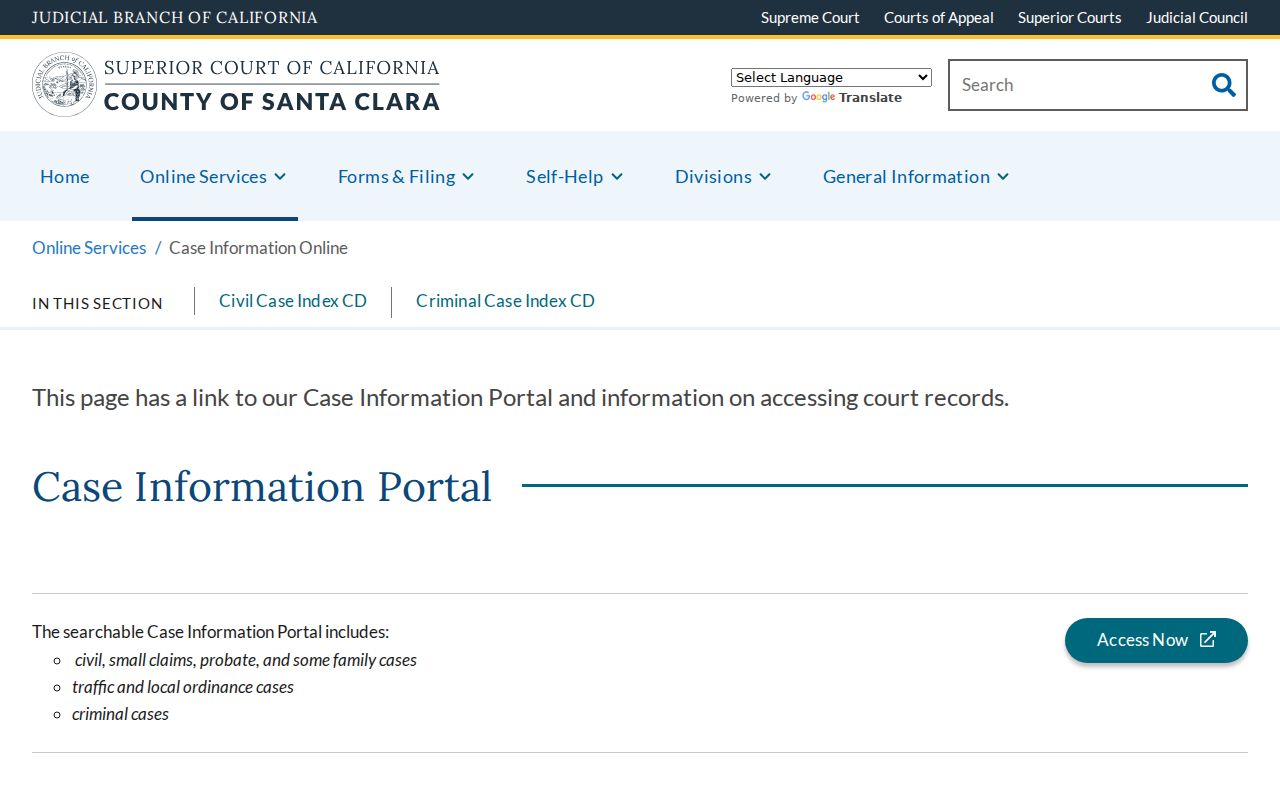
The search screen is a starting point, not a full index.
- Docket
- The running list of case events, filings, hearings, and orders shown in a court record.
- Index versus image
- An index helps find a case or instrument; an image is the underlying filing or recorded document.
- Certified copy
- A copy bearing the custodian's certification, which can carry an added fee and a separate request rule.
PACER handles the federal side. It covers Northern District of California and bankruptcy cases by party or case number. Terminals at the San José federal courthouse offer another route, though PACER carries account and per-page charges, so confirm the current schedule before ordering.
Santa Clara County Custody Searches Need Context
Each custody system has a narrow scope. The County Department of Correction booking search takes a booking number, a Personal File Number, or a name paired with a date of birth or booking date. Results cover current county-jail bookings only. A booking number marks an arrest, while the PFN identifies a person in the court computer system, as the county explains.
The Santa Clara Superior Court documents its criminal-records procedure in a guide. The county criminal index carries cutoff and exclusion rules. A name search will not open juvenile, medical, victim, jail-security, sealed, or protected material.
A separate statewide layer is the California Department of Corrections and Rehabilitation locator. Its search accepts a CDCR number or a last name after the disclaimer, and name results can be refined by age range. A hit can show a name, age, CDCR number, current institution, admission date, commitment county, and parole information. The locator updates daily. Even so, it is expressly informational and incomplete.
The public Megan's Law site works differently. Name, map, and address modes sit behind a statutory disclaimer. A profile can then show aliases, a physical description, offense and registration details, and a mapped residence or a ZIP- or city-level location depending on disclosure classification. The site itself warns against republication, threats, or harassment.
The criminal case search guide is the official page behind this Santa Clara County custody image. It shows the court's path to criminal case records. Custody results answer one question at a time. They are not a street directory of Santa Clara County residents.
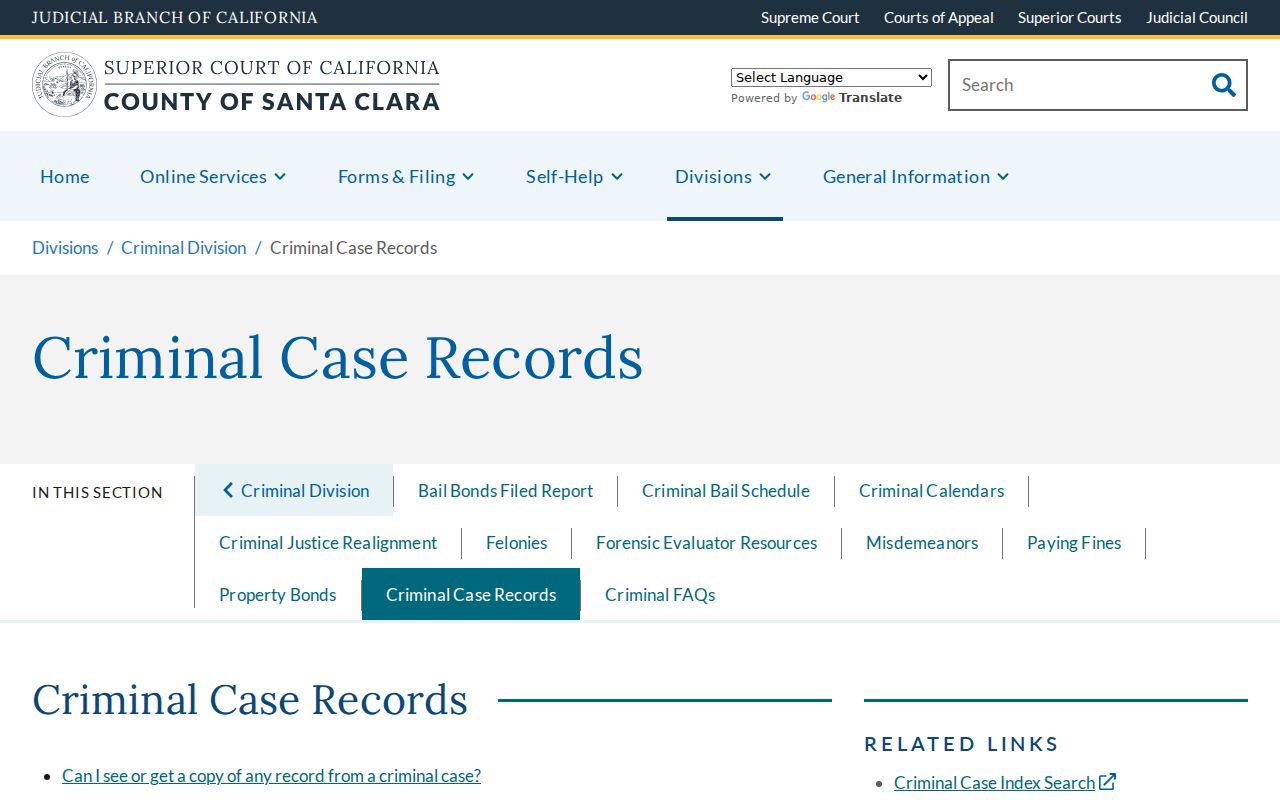
The guide shows how the court opens records, with the limits built into each result. The CDCR locator adds a second custody layer.
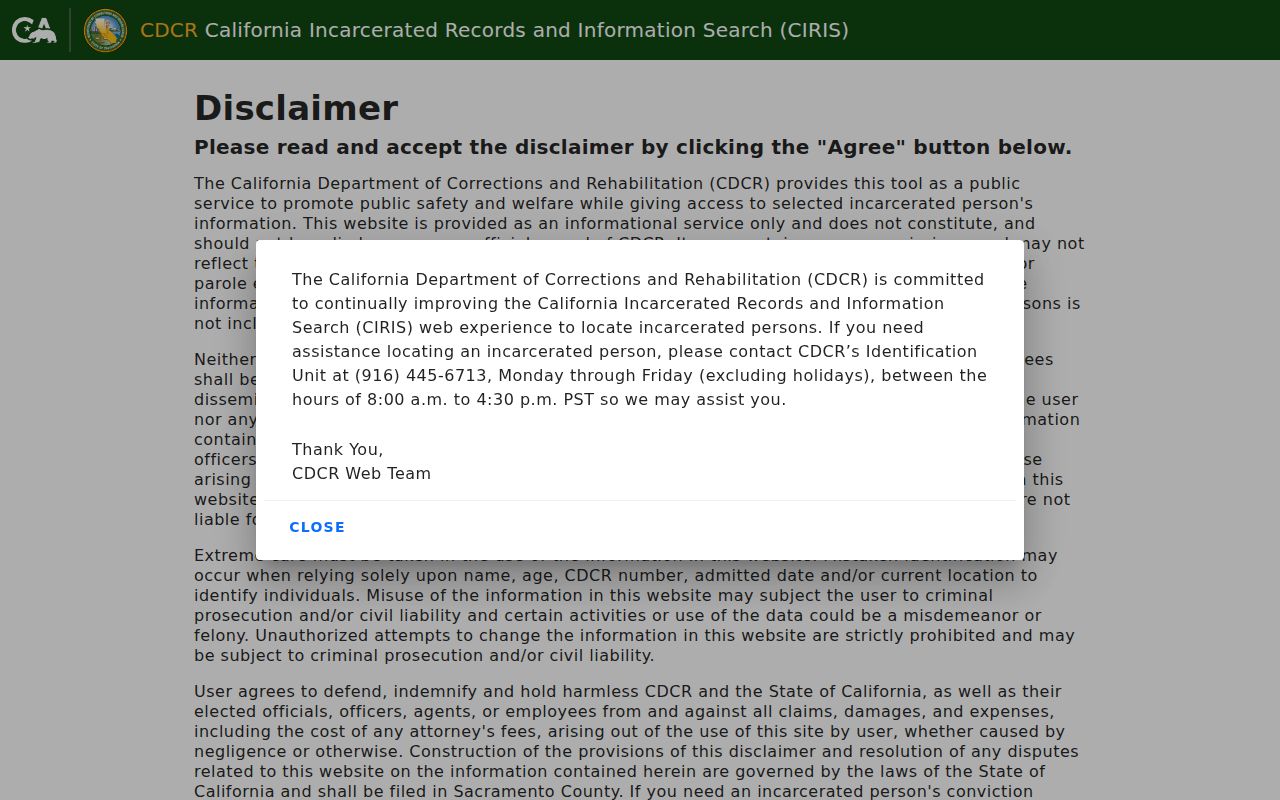
Label any custody hit as custody information, never as proof of a current home address. The Megan's Law search carries its own public-use warning.
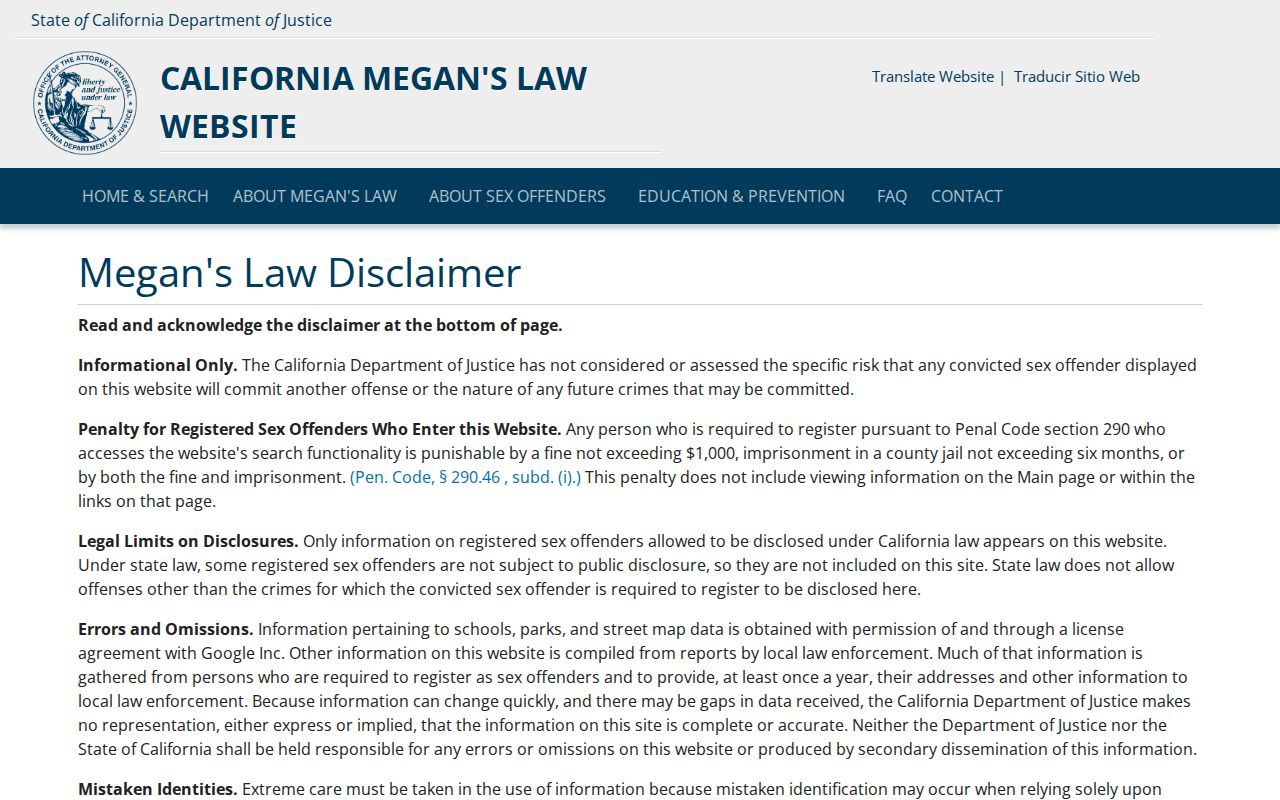
Use public-safety records only for the purpose the custodian and the law allow. That warning is worth keeping.
Santa Clara County Vital Lookup Rules
Vital records locate events, not addresses. The County Clerk-Recorder holds Santa Clara County births and deaths from 1873 forward and marriages from 1850 or 1851 forward. California CDPH holds statewide events from July 1905. Choose the county when the event is known to have occurred here. Turn to CDPH when only California is known.
- Birth
- County coverage begins in 1873; CDPH is statewide from July 1905. Informational copies are available, while authorized copies require an eligible relationship and sworn identity statement. County fee: $34; CDPH fee: $31 in 2026.
- Death
- County and CDPH coverage follows the same local and statewide dates. Informational or authorized copies are available under different rules, and signatures and SSNs are redacted from informational copies. The 2026 fee is $26.
- Nonconfidential marriage
- County records begin in 1850/1851, with CDPH coverage for its stated years. Informational copies are available and authorized access is limited. The 2026 fee is $19.
- Confidential marriage
- The county where the license was issued holds the copy. A party or court order is required; the county fee is $19 when eligible.
- Divorce
- The Superior Court holds the actual file. CDPH certificates cover 1962 through June 1984 and are limited abstracts, not decrees; CDPH lists an $18 fee.
Birth and death requests reach the county in person, by mail, or through its authorized online vendor. Walk-in service happens at 110 W. Tasman Drive, First Floor, San José, Monday through Friday, 8:00 to 4:30. Walk-ins are fine. An appointment is still encouraged. The county reports same-day processing in the ordinary course. Mail requests need the county form, a check or money order, and a notarized sworn statement for an authorized copy. A no-hit search still costs the statutory fee.
CDPH runs its own route with VS 111, VS 112, and VS 113 forms by mail. Older leads exist too. County Archives offers appointment access to specific pre-1920 birth and death index books, though it issues no certificates. Newspapers, church registers, cemetery files, and library databases can narrow a date before an official copy is ordered.
The county marriage request page anchors this record image.
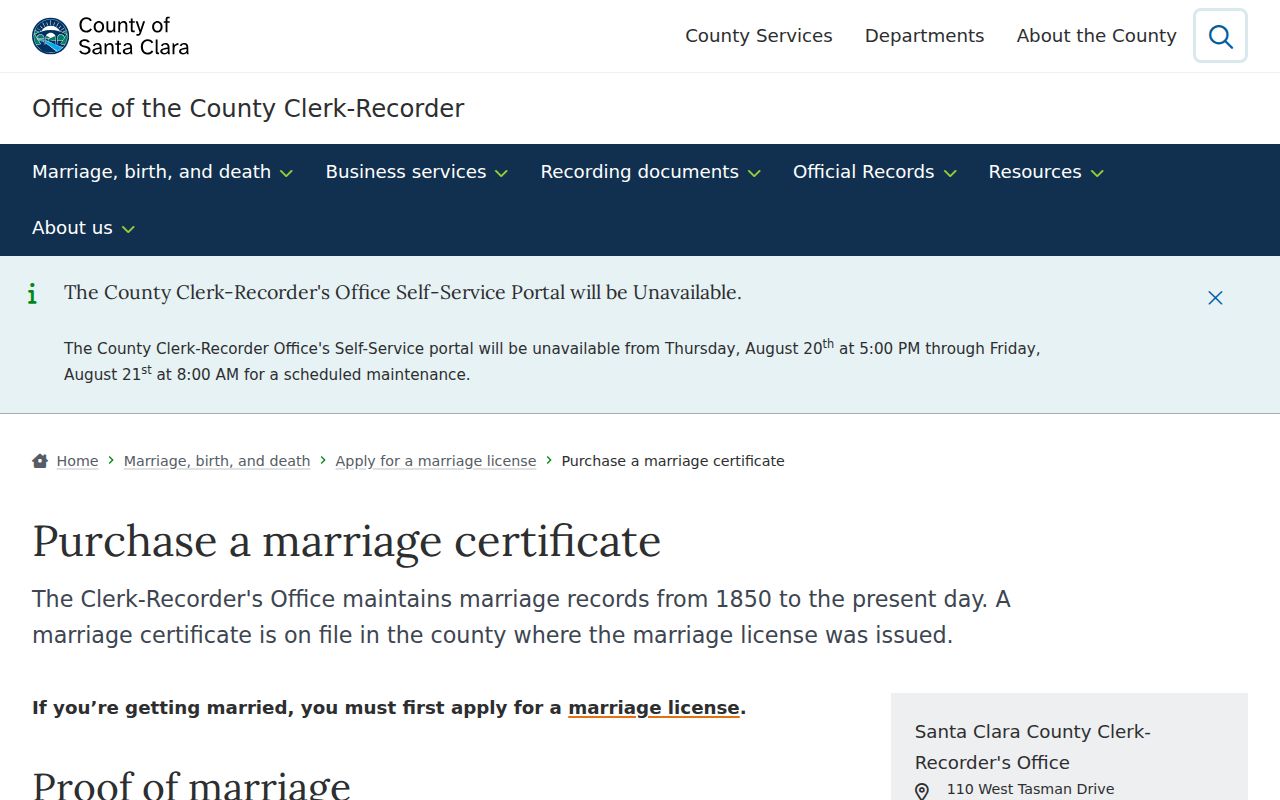
A certificate confirms an event and a stated relationship. It does not, by itself, prove where a person lives now.
[RESEARCH GAP: the manifest did not capture the county vital-record application screen; use the linked form and current Clerk-Recorder instructions.]
Santa Clara County Voter Lookup Is Personal
Voter lookup here is personal. The county's Look Up Voter Registration application checks a single voter, not a public name or street directory. It asks for a first name, last name, birthdate, and a driver's license or state ID route, or the last four digits of a Social Security number. No public browse exists. Wildcards, ZIP codes, precincts, exports, and sorting are all absent.
| Input | Documented use |
|---|---|
| First Name and Last Name | Registrant's own given name and surname |
| Drivers License or ID | Conditional identity credential |
| Social Security Number, last four digits | Alternate identity credential |
| Birthdate | Required date in MM/DD/YYYY form |
| Go | Runs the personal status query |
A qualified requester seeking voter files for election, scholarly, journalistic, political, or governmental purposes applies through the Secretary of State. The statewide file costs $100, a request covering up to ten named voters runs $30 per record with a $100 ceiling, and counties set their own prices. State processing takes 7 to 14 business days. Applications must state a qualifying purpose and include a security plan, nondistribution acknowledgments, identity information, and payment. The Santa Clara County Registrar of Voters operates from 1555 Berger Drive, Building 2, San Jose, weekdays from 8:00 a.m. to 5:00 p.m., with phone lines at (866) 430-8683 and (408) 299-8683. Registration mail goes to the county PO Box. The county publishes no current price or request form for its own file, so confirm cost and format directly with the ROV. A CPRA request is not a workaround for restricted voter data.
Safe at Home participants and other confidential categories stay out of otherwise approved files. A district finder returns precinct and district geography for an address. It does not disclose the voters living there. For a county booking result that cannot be located, Administrative Booking can be reached at 408-299-2305, with the Main Jail at 150 W. Hedding Street in San José and Elmwood facilities in Milpitas as separate custody channels. CDCR's Identification Unit, at 916-445-6713 on weekdays from 8:00 to 4:30 Pacific time, is the documented fallback when its locator fails to find a person.
[RESEARCH GAP: the manifest did not capture a dedicated voter-lookup screenshot; the field inventory and linked official form remain the documented route.]
Use Probate, Adoption, and School Records
Some questions call for a record built around a relationship. That record differs from a broad resident search of the Santa Clara County residents directory. For an heir or estate question, start with the Superior Court probate index. Then pull the petition, notices, appointment, or order from the clerk. A petition only alleges relationships; a signed order is stronger evidence. Recorded deeds can confirm the representative's later tie to a parcel.
Adoption works differently. California adoption records are confidential. So a birth-parent search must go through California Department of Social Services and CDPH adoption information rather than inference from unrelated records. Consent and court rules control release. The right answer may be an authorized process, not a public name match.
For former classmates, turn to history collections. The San José Public Library California Room holds county high-school, middle-school, and university yearbooks. Santa Clara University Archives offers digitized Redwood yearbooks from 1902. It also holds a student-newspaper collection from 1922 to 2013. The modern Santa Clara alumni directory requires eligible-user registration and login. That makes it a voluntary contact channel rather than an open residents roll. Obituary work fits the library's newspaper workflow. SJPL describes California Digital Newspaper Collection coverage through 1922, NewsBank for later years, microfilm, and the California Death Index for date clues. A memorial or yearbook fixes a historical identity, not a current location.
Search Santa Clara Names Across Languages
Santa Clara County records reflect a multilingual population and many naming systems. Compound surnames, diacritics, transliteration, married-name changes, Anglicized given names, and reversed given-name order all appear here. Any one of them can split a person across a city directory or voter roll. Try the exact form first. Then log each variant in your notes instead of silently merging results. A neighbors search in Santa Clara succeeds or fails on this discipline.
Anchor every variant to a second fact. Pair a court party role with a filing date. Pair a deed party with the legal description and recording number. Test a professional license against its license number and status. Check a BizFile result on the entity number, agent, filing date, and business address. These checks sharpen a resident lookup without turning a name similarity into a claim.
Modern indexes sometimes omit a name form. The California Room can help then. Its yearbooks, newspapers, maps, and clipping files preserve alternate forms. Community history collections also preserve family clues that mainstream street directories missed. Read the front matter. Search the index terms the collection itself uses. Note whether the source is historical, current, voluntary, or restricted.
Santa Clara County Resident Lookup Privacy Boundaries
California privacy law sets firm limits on any Santa Clara County resident lookup. Voter home addresses, phone numbers, email, signatures, and identification numbers stay confidential. The Elections Code's controlled access route governs that protection. The federal Driver's Privacy Protection Act shields DMV residence data too. Utilities, delivery accounts, and household-member details are not public resident rolls. So a gap in a residents directory record often reflects a legal shield rather than a missing person.
Safe at Home takes this further. The program gives eligible survivors and threatened public participants a substitute mailing address with confidential mail forwarding. Under Government Code section 6208.1, agencies must stop public display of a participant's home address or phone once the required demand is made. Someone enrolled lawfully may simply not appear in a street directory or resident lookup for Santa Clara County. That silence is protection working as intended.
Corrections follow two separate paths. For a wrong government record, contact the custodian that created or maintains it. That custodian may be the recorder, assessor, or elections office. For commercial-broker copies, California's Delete Request and Opt-out Platform, called DROP, helps. It lets a verified resident send one request to registered brokers. DROP cannot touch county deeds, assessor parcel records, or court files that the records office lawfully retains. Keep the county correction path and the broker deletion path distinct.
Scammers complicate things. A fake demand can quote a real parcel number, case number, or a relative's name and still be false. Check the agency through its own directory or the California Attorney General consumer complaint channel. Save the message and any payment demand. A correct address is never proof that a caller is authorized.
Note: A careful lookup protects the person named. It also gives the custodian a clear question when a correction is needed.
Lawful use. Santa Clara County resident-search records are for personal, lawful research, family history, and public-safety awareness. Do not use a name, address clue, court result, or protected-record detail to stalk, harass, threaten, or intimidate anyone.
Uncertainty is a stop sign. When a deed, voter roll, and assessor parcel do not converge on one Santa Clara County resident, resist guessing. A restrained lookup in the residents directory protects the person being researched and leaves the records office a clean, answerable question for any correction or copy request.