
Start With Santa Clara County's Resident Question
Name the fact that needs proof. An exact address points first to the Assessor and the parcel map. A suspected owner points to an assessment record. The recorded deed follows. Court questions belong in the Superior Court Case Information Portal. Birth, death, and marriage questions belong with the Clerk-Recorder or a state vital-records office. Family-history work often starts in the California Room, a county archives index, old newspapers, or a directory volume instead of a current web search.
Keep each record's role in view. An assessor result describes a parcel and its assessment facts, never who sleeps there. A deed names parties to an instrument. A directory lists people found during one canvass. A voter record reflects a registration claim, where access is lawful. None of those labels alone proves that everyone in a household lives at the address today.
- Write down the strongest starting clue: full name, middle initial, known address, APN, case number, license number, or business entity number.
- Use the Santa Clara County Assessor search for a situs address or APN, then save the parcel identifier and any latest title-transfer document number shown.
- Check the matching record keeper. Use the court portal for a case index, the vital-record form for an event copy, or the voter status tool for the registrant's own status.
- Move to the Clerk-Recorder counter for a deed chain, or to the California Room and Archives for older names, addresses, maps, and local collections.
- Compare two independent facts, label each address by its source and date, and stop at “not established” when the records do not converge.
Match the question to its custodian. Then run index to source image, clue to corroboration. That discipline keeps a quick Santa Clara County residents directory lookup from turning a mailing address, an old entry, or a namesake into a claim about a living person.
Where Santa Clara County Keeps Resident Records
Santa Clara County offices anchor the records map. The Clerk-Recorder holds recorded real-estate instruments and county vital certificates. The Assessor maintains parcels and assessment information. Superior Court supplies public case indexes. The Registrar of Voters controls restricted voter data and personal status checks. City clerks handle permits, code material, and municipal files. Land-use jurisdiction follows the city or the county, not always the postal city.
Access channels differ. Real-estate research at the Recorder happens in person at 110 W. Tasman Drive in San José, with counter images and Digital Reel access. The Assessor runs a free web search by address or APN plus counter help. San José city records can be requested in writing, by mail, email, fax, or telephone. Requests can also be made in person. The public court index is online. Filings show at a courthouse terminal or by request from the clerk.
Santa Clara County Clerk-Recorder
110 W. Tasman Drive, First Floor
San José, CA 95134
408-299-5688
Registrar of Voters
1555 Berger Drive, Building 2
San José, CA 95112
(866) 430-8683
Note: The office that holds a record may stay the same when its public counter, hours, or request path changes.
Build a Santa Clara County Parcel Trail
The Assessor Real Property Search is a parcel starting point, not a name-searchable residents directory. Three public modes exist. Simple Address Search, Advanced Address Search, and Search by APN cover the entry paths. The address must be a situs, not a tax mailing address. That means the physical property location. The terms checkbox and reCAPTCHA sit along the search path. An APN goes in with or without dashes. Use the format the county shows.
| Field label | Type | Required | Format or options |
|---|---|---|---|
| Property address | Autocomplete text | Yes | Select a situs address suggestion. |
| Street number | Text | Required in advanced mode | Numeric portion of the address. |
| Street direction | Dropdown | Optional | Directional values exposed by the site. |
| Street name | Text | Yes in advanced mode | Street base name. |
| Street type | Dropdown | Optional | Road, Street, Drive, Way, and other suffixes. |
| Unit | Text | Optional | Unit identifier when supplied. |
| City | Dropdown | Yes in advanced mode | County city or locality choices. |
| APN number | Text | Yes in APN mode | Eight digits, with or without dashes. |
Once a result appears, capture what the official workflow exposes: APN, situs, property characteristics, assessment information, and the latest title-change document number. The APN matters most. The public form offers no owner-name, ZIP, radius, whole-street, export, or date controls. Those limits are real. Ownership history and protected data may still need the Assessor counter at 130 W. Tasman Drive or a request to the office.
The county GIS entry point layers parcel geometry with jurisdiction, planning, zoning, district, hazard, and aerial detail. Search an address or APN. Select the polygon. Save the APN and jurisdiction, then carry that identifier to the Assessor or a city permit custodian. A map supplies geographic context. It is never a legal survey, a deed, or a complete household roster.
The Santa Clara County Real Property Search shows the address and APN modes that begin the parcel trail.
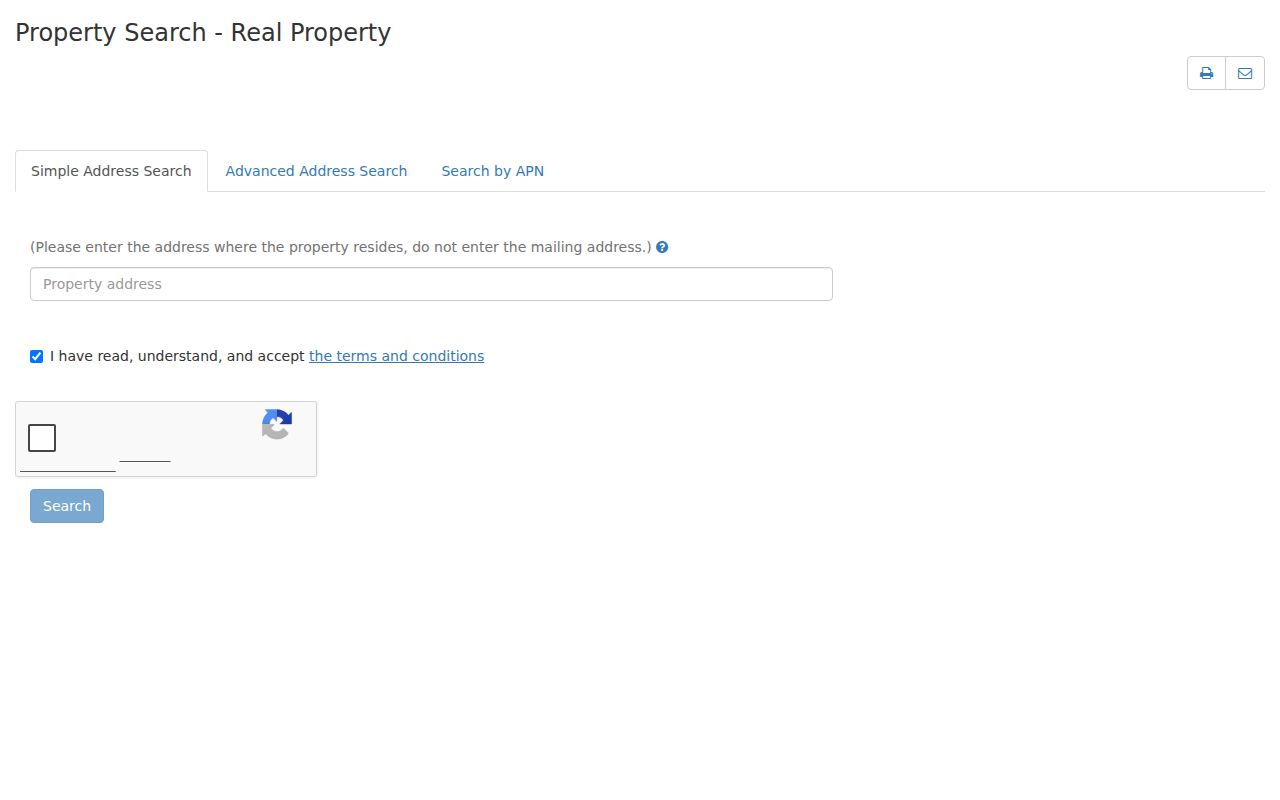
A parcel result can guide your next record request. It is not proof of occupancy. The Santa Clara County GIS applications add the map context for comparing parcels and jurisdictions across the county.
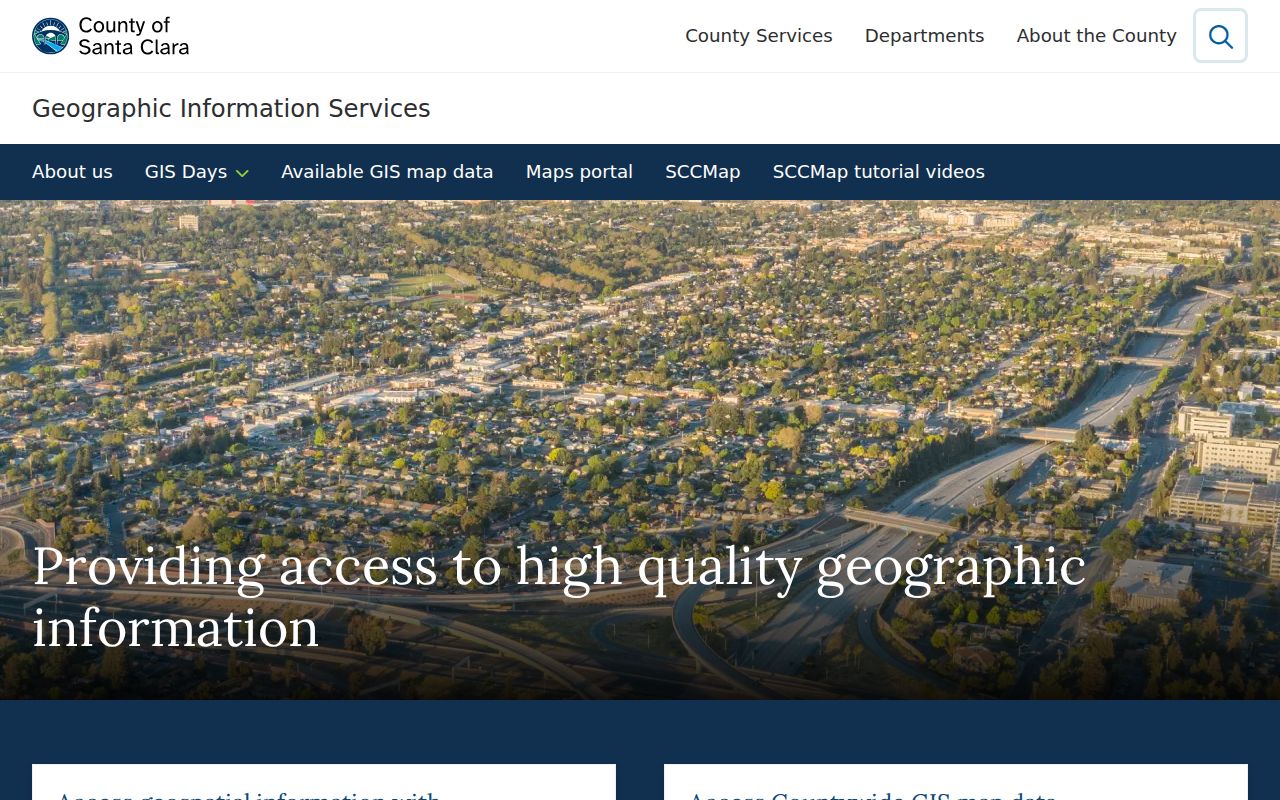
Every street search here runs on one number. The APN is the bridge. It spans the visible polygon, the property result, and a later deed or permit search. The detailed address chain continues in the Santa Clara County street directory workflow, where parcel, map, deed, permit, and historical address clues stay together.
Follow Santa Clara County Recorded Documents
The Recorder's index runs on names, not streets. Grantors and grantees are the organizing principle. Street addresses simply do not appear in the official-record index. The bridge is the Assessor's latest title-transfer document number. Start with the address or APN in the property search. Carry that document number to the Clerk-Recorder. The instrument itself will name the buyer, seller, recording date, legal description, and any earlier transfer it references.
Then work the chain backward. Search the seller as a prior grantee. Repeat with each earlier instrument until the chain thins out. Records before 1994 may still live in book and page form. Digital Reel is available at the counter. The county expects real-estate research and viewing to happen in person. Staff will not run the title search for you; typical customer research takes about 15 to 45 minutes. A known document can go through a mail or copy-order route. A vague request for everything tied to an address, though, is no substitute for working the counter index yourself.
The Recorder counter sits at 110 W. Tasman Drive, open Monday through Friday from 8:00 a.m. to 4:30 p.m. Plain copies reproduce a record. Certified copies add the Recorder's certification. A street name, number, trust name, or parcel identifier may change over time. The document's legal description is the control.
Note: A deed names parties to a recorded transfer; it does not list every person who may have lived at the situs.
Current Santa Clara County Directory Sources
Think of a current Santa Clara County residents directory as several partial indexes. It is not one master list. Each piece answers a different question. Each carries its own access rule too. The court portal can tie a name to a case and show the party's role. The voter status tool verifies one registrant at a time. The Assessor links a street address to its parcel. The Recorder connects named parties to recorded instruments like deeds. Libraries and community archives preserve listed residents from earlier decades. They do not hold a modern roll of everyone. Treat any single residents directory entry as a lead. Trust it only when a second record confirms the date and role.
| Source | Who or What Appears | Keeper | Access |
|---|---|---|---|
| Real Property Search | Parcel, situs, APN, assessment facts, latest title document | County Assessor | Free address or APN web search; counter help |
| Recorded-document index | Grantors, grantees, document types, dates, and numbers | Clerk-Recorder | In-person index, image viewing, known-document orders |
| Case Information Portal | Parties, case type, status, dates, and docket information | Superior Court | Online index and courthouse terminals |
| My Voter Status | One registrant's registration status and election-facing data | California Secretary of State | Identity inputs; not a public browseable roll |
| Local-history collections | Historical household names, addresses, school and community clues | Libraries and archives | Digital objects, in-room shelves, or appointment |
That structure also explains why a name search stalls. A hit might identify a legal party, a registered voter, or a listed householder. It might also be someone tied to a case, but that alone does not prove where the person lives now. Pull a second source that adds a different kind of fact. An address, a date, a middle name, or a parcel number turns a match into something firmer. So does a family relationship.
- Roll
- An office's organized record of parcels, assessments, voters, taxes, or another defined set.
- Index
- A finding aid that points to a record by name, number, date, or party role.
- Criss-cross directory
- An address-first historical directory that lists a householder for a street and publication year.
- Parcel
- A mapped property unit identified by an APN for assessment and geographic reference.
Context for Santa Clara County Court Names
The Santa Clara Superior Court runs a Case Information Portal. It indexes civil, small claims, probate, some family, traffic and local-ordinance, and criminal matters. A case number is the safest search key. A party role helps too. You can also search by case name or defendant name with a birth date. Other keys include filing month and year, filed or disposed date ranges, status, case type, calendar date, department, or attorney. A name alone is far riskier, since common surnames crowd the index.
Coverage has limits worth knowing. The online criminal index starts with 2004 cases. Family records online generally reach back only about ten years. Confidential parentage, adoption, juvenile, and sealed files stay off the portal entirely. The public index can display a register of actions, hearing details, and a disposition. The filings themselves are usually not online. To read an open record, use the courthouse terminals. Clerk copies run $0.50 per page plus certification fees. You request pleadings at the courthouse where the case was filed, in person or by mail with a self-addressed stamped envelope.
Calling the clerk is useful for confirming a division or copy procedure. It is not a way to run an unrestricted person search. Federal cases belong to PACER through the Northern District of California's San José access point. Keep county court results, federal results, and index entries distinct in your notes. The Santa Clara Superior Court Case Information Portal is the official online starting point. Use it for the local case index.
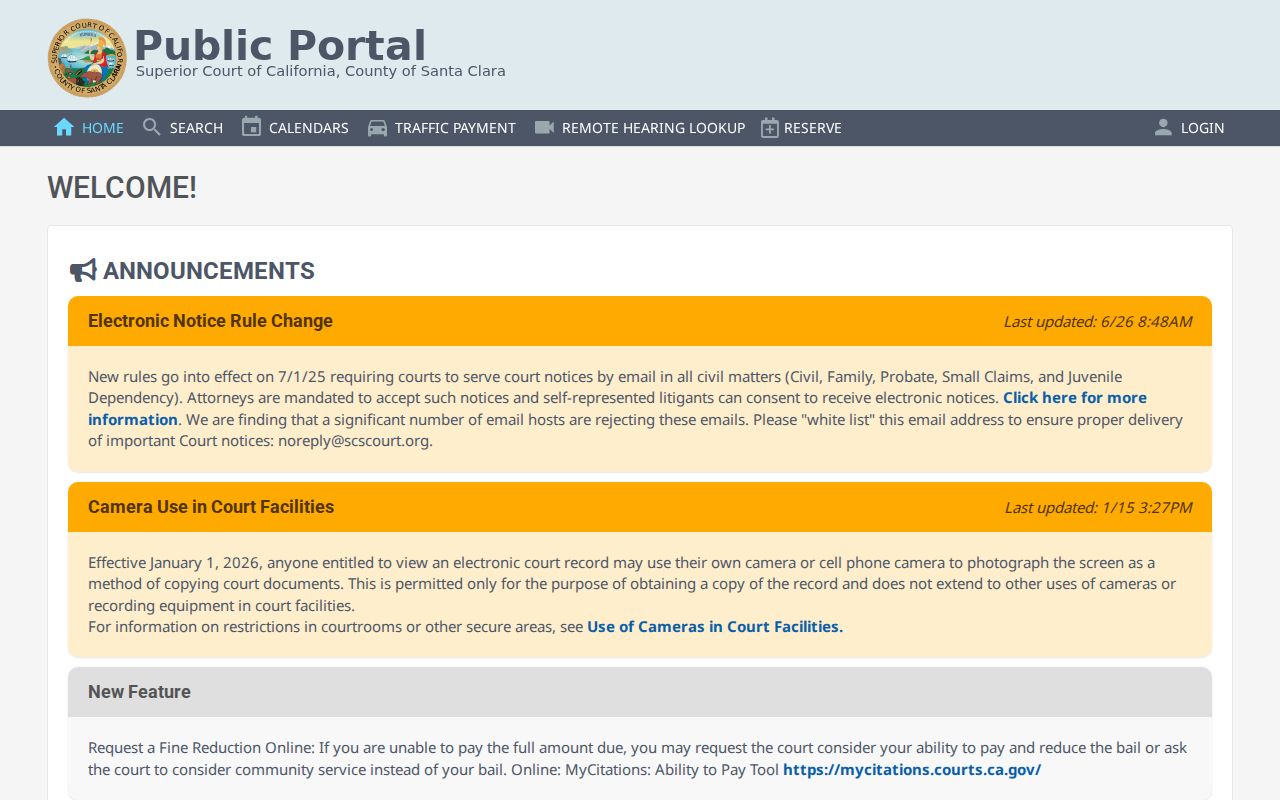
The court screen is only a finding aid. When the clerk's file is open and available, that file holds the underlying filing itself.
Note: A court party entry establishes a case connection, not a current address or a complete identity match.
Santa Clara County Vital Records and Identity
Birth records here go back to 1873, and marriages to about 1850. The Clerk-Recorder in Santa Clara County keeps them. You can order through an authorized online vendor, by mail, or at the counter at 110 W. Tasman Drive. Base fees for 2026 are set. They are $34 for a birth record, $26 for a death record, and $19 for a marriage record. Paying by card at the counter adds $2.50. The vendor route adds a $7 convenience charge plus shipping. Walk-in orders are usually done the same day. The online vendor, though, quotes four to six weeks for delivery.
California draws a firm line between two kinds of certified copies. An informational copy of a birth, death, or nonconfidential marriage record can go to almost any requester. It carries redactions and an identity-use legend. An authorized copy is different. You need an eligible relationship or some other statutory basis, plus a sworn statement, and a notarized statement if you mail the request. Confidential marriage copies go only to a party or by court order. Adoption and original birth records follow their own separate restrictions.
CDPH serves as the statewide fallback. It covers events from July 1905 onward and dissolution certificates from 1962 through June 1984. For older material, the County Archives takes appointments. You can view pre-1920 birth and death index books there. Archives staff cannot issue the certificate itself. Newspapers, church registers, cemetery files, and genealogy databases can help you pin down an event first. Then the official copy is easier to order.
Santa Clara County Voter Tool Limits
The California My Voter Status form checks a person's own registration, not a public residents directory. It requires first name, last name, and birthdate. It also requires a driver's license or state ID path. A last-four Social Security number works too. No name-only browse, wildcard, street, ZIP, precinct, export, or result-sort mode exists. An address-based district finder returns precinct and district geography. It never shows the names of people at an address.
Voter-registration data is restricted under California Elections Code sections 2187, 2194, and 2157.2. Election, scholarly, journalistic, political, and governmental users may apply for an authorized file. The state charges $100 for a statewide file. Alternatively, up to ten specifically identified voters cost $30 per record with a $100 maximum. State processing takes seven to fourteen business days. Applications ask for the qualifying purpose, requested product, security plan, identity information, and nondistribution acknowledgments. A CPRA request offers no workaround.
The Santa Clara County Registrar of Voters counter sits at 1555 Berger Drive, Building 2. It is open weekdays from 8:00 a.m. to 5:00 p.m. Phone lines are (866) 430-8683 or (408) 299-8683. Confirm the current county-file fee and request form directly with the Registrar. The county publishes no posted price for its file.
The California My Voter Status form shows the identity checks that block a general browse tool. Those checks keep a public Santa Clara County voter roll from becoming one.
Safe at Home participants and certain other confidential categories stay out of even authorized files. So a missing name never proves a person is unregistered in Santa Clara County.
The Historical Santa Clara County Directory Trail
For historical directories, start at the San José Public Library's California Room. It claims every published San José directory from 1870 to 1970. Its format notes say print runs 1870 to 1979 and microfilm 1870 to 1960. Take both statements at face value, since individual years can carry gaps. Fully digitized volumes cover 1870, 1887, and 1920, plus San José business sections from 1870 through 1918.
The county towns reach well beyond the San José title. Separate holdings include Gilroy 1964 to 1983, Los Gatos 1956 to 1967, Morgan Hill 1968 to 1983, and Mountain View 1962 to 1968. They also include Palo Alto 1938 to 1978, San Martin 1970 to 1983, Sunnyvale 1964 to 1968, and San José suburbs 1968 to 1974. Haines criss-cross and Pacific Bell reverse directories start in the mid-1960s. They open address-first research across cities and unincorporated pockets for anyone tracing past residents of Santa Clara County.
Santa Clara County was among California's original 27 counties, created in 1850. Deeds, courts, taxes, probate, and government records therefore begin in a different system from the older mission, pueblo, and Mexican land-claim papers. Visit the California Room at King Library, fifth floor, 150 E. San Fernando Street, San José. Hours are Monday 1 to 6, Tuesday through Friday 11 to 6, and Saturday 1 to 6. It is closed Sunday, and the phone is 408-808-2167. Onsite, the California Room Index points to clippings, maps, primary sources, scrapbooks, and vault items. These often escape the regular catalog. The full story of the Santa Clara County city directory collections sits naturally beside these access details.
Santa Clara County Family Clues Beyond Rolls
Family history rarely lives in one countywide roll. Many of the best leads sit in collections built for a school, a congregation, or a neighborhood. The California Room keeps county high-school, middle-school, and university yearbooks. It also holds newspapers, clipping files, microfilm, permits, maps, aerial photographs, and telephone books. University archives contribute searchable yearbooks, student newspapers, and course catalogs. They also offer scanned Mission Santa Clara baptism, marriage, and burial registers.
History San José holds personal and family papers, organization records, photographs, maps, and artifacts. It also documents Silicon Valley community history. For obituaries, the California Room leans on the California Digital Newspaper Collection through 1922. NewsBank covers later spans, alongside library microfilm. The California Death Index helps pin down a date. Funeral-home memorials help too, though coverage and retention vary widely. A yearbook entry, obituary, or sacramental record is a historical clue only. Never stretch it into a claim about where someone lives now.
These collections matter most when a mainstream Santa Clara County city directory runs thin. Chinese American and Japanese American community archives can preserve names and family ties. Standard volumes often omitted those names or spelled them inconsistently. Try compound surnames, diacritics, transliterations, and shifted given-name order. Then confirm any match with a dated address, event, or official record.
Eras leave different trails. Orchard-era families of the Valley of Heart's Delight appear in land deeds, agricultural records, maps, directories, and newspapers. Postwar Silicon Valley tract growth shows up instead in subdivision maps, permits, yearbooks, and later address records. Match the source family to the period before declaring a name absent from Santa Clara County.
Note: A community collection can reconnect a family story without functioning as a public modern household roster.
Santa Clara County Directory Geography
Santa Clara County holds fifteen incorporated cities plus unincorporated communities. Campbell, Cupertino, and Gilroy sit on the roster. So do Los Altos, Los Altos Hills, Los Gatos, Milpitas, and Monte Sereno. Morgan Hill, Mountain View, Palo Alto, San José, Santa Clara, Saratoga, and Sunnyvale round out the list. A postal city is not always a municipal boundary. The Assessor even tags places that lack city halls. Among them are Agnew, Alviso, Coyote, Holy City, Moffet Field, Mount Hamilton, Redwood Estates, San Martin, Stanford, Watsonville, and plain Unincorporated.
Geography decides who holds a permit or code record. San José runs the deepest municipal public-record route. It spans online requests to written, mailed, emailed, faxed, telephone, and in-person channels. Other cities keep their own planning systems. Unincorporated parcels answer to County Planning and Development instead. Confirm jurisdiction with the APN and GIS tools first. That habit keeps a request from landing on the wrong clerk's desk.
San José, the county seat, is also where a postal line misleads most easily. Stanford-area, mountain, rural, and south-county records may sit in separate collections. Those span city, county, library, and historical holders. Keep place name, postal ZIP, city limit, assessor locality, and record custodian as separate fields. A Santa Clara County residents directory search works better that way.
Corroborate a Santa Clara County Name
Namesakes demand at least two independent anchors. Pair a full name with a middle initial, a date, a parcel, a case role, or a document number. A school year or an entity number can serve too. California's multilingual communities compound the problem. Compound surnames, transliteration, diacritics, and shifted name order layer over ordinary spelling variation. Preserve the first official spelling you meet. Test variants afterward. But never merge records just because a first and last name happen to match.
Professional indexes corroborate identity without becoming resident rolls. A license search may show a name, number, status, dates, and public discipline fields. BizFile can show an entity name, number, status, agent, and filed statements. Treat an agent or license address as a contact point. It is not proof of a home address.
The California Department of Consumer Affairs license search works well whenever the question turns on a professional record.
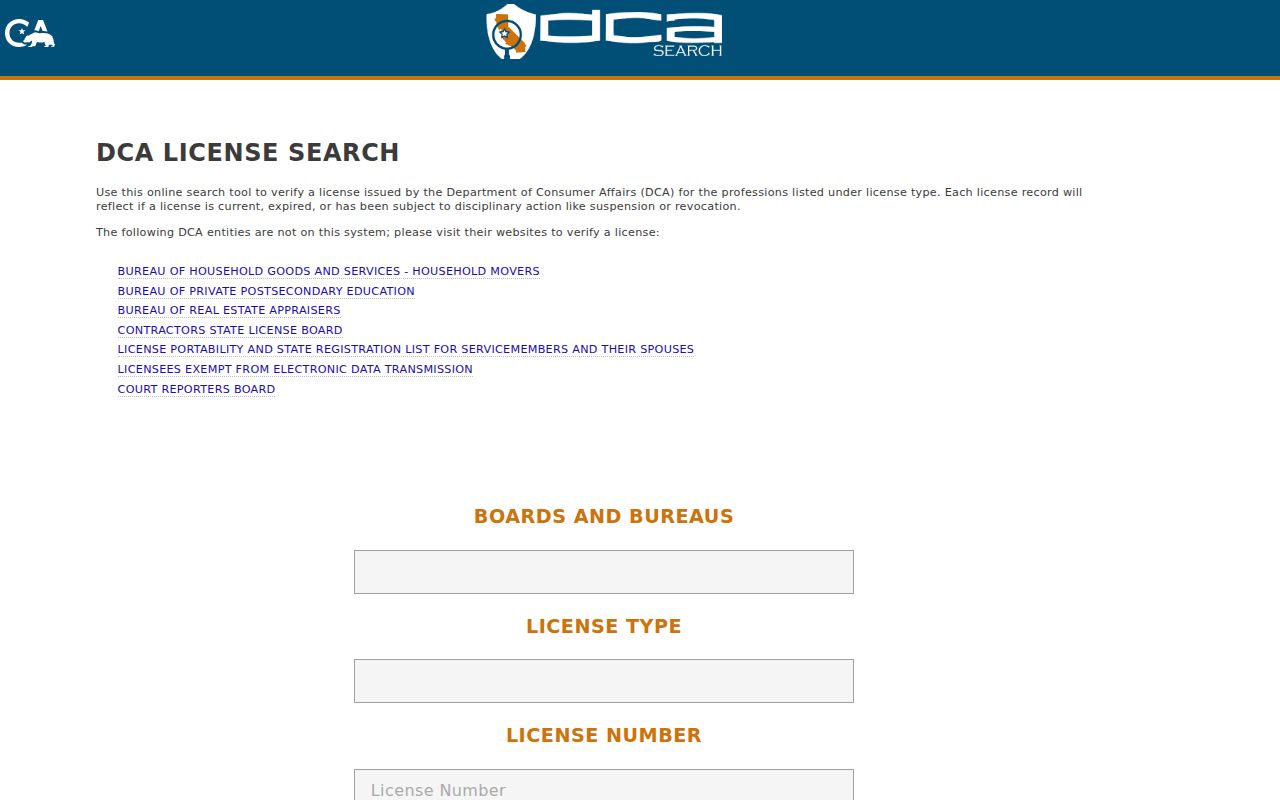
Read the status and number as the official identifiers. Follow the board's public record rather than inferring residence from a contact field. The California Secretary of State BizFile search opens a separate entity trail by business name or filing number.
Keep an entity, fictitious business name, license, court party, deed party, and parcel owner in separate evidence-log columns. Collapsing them invites false matches.
Limits of Santa Clara County Residents Directory
Official records are partial by design. A deed can name a trust, joint owner, or entity while omitting the household. Canvass gaps, publication lag, city limits, or unlisted status can drop someone from a directory. Tax mailing contacts can differ from the situs. Utilities, delivery accounts, and DMV address data never form public resident rolls. Confidential voter, sealed, and protected vital records stay restricted.
| Record path | Best evidence | Do not infer |
|---|---|---|
| Assessor and GIS | Parcel identity, situs, APN, map context | Every person inside the parcel |
| Recorder instrument | Named parties, legal description, recording event | Current occupancy or family relationship |
| Court index | Party role, case context, docket event | Identity from a namesake alone |
| Directory or yearbook | Listed person, address, school, or period clue | Present address or complete household |
| Commercial people-finder category | Possible lead assembled from mixed sources | Custodian-level accuracy or current proof |
Lawful personal use. Santa Clara County records support genealogy, civic research, family reconnection, and source verification. Do not use an address or name record to stalk, harass, intimidate, or harm another person.
A weak match deserves a better source. If official facts do not converge, record the uncertainty and leave the resident relationship unestablished.
Santa Clara County Records in Motion
Dates and access routes now shape the search. County Assessor and Clerk-Recorder services moved to the North County government center at 110 West Tasman Drive in 2025. The custodian and old deed citations did not change. Yet a stale saved map or office note can send you to the wrong counter. Confirm current service instructions before visiting.
A separate 2025 project brought Stanford RegLab and Princeton researchers to the county. Their artificial intelligence scans historic recorded documents for racially restrictive covenants under California's AB 1466 framework. The result is a searchable historical layer. It does not erase the original deed or make an unenforceable covenant valid. Read the instrument and any later modification together.
Property-tax bills, assessment data, and recorded instruments describe the same parcel for different legal purposes. They update on different schedules. Keep the APN constant while comparing them. California's Delete Request and Opt-out Platform, launched in January 2026, can direct covered data brokers to delete matched commercial copies. Deeds, court files, and assessor records remain untouched. The California DROP platform corrects commercial copies, while an error in an official record belongs with the record custodian.
Note: A new portal or office address changes the access path, not the historical meaning of a recorded document.